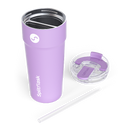
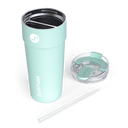
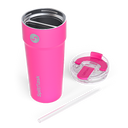
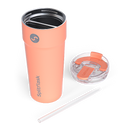
FREE US SHIPPING on ALL Tumblers


The Splitflask guide
Can You Carry Hot and Cold Liquids at the Same Time Without Temperature Bleed?
The short answer
Yes—a purpose-built, independently insulated dual-chamber tumbler can carry a hot drink and a cold drink at the same time. Separate chambers greatly limit direct heat exchange, although no portable container eliminates every source of temperature change. Starting temperature, ambient heat, lid openings, and insulation quality still matter.
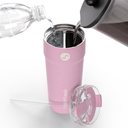

A conventional one-compartment tumbler cannot keep two liquids separate. A genuine dual-chamber design can—but the two chambers need their own walls, seals, and drinking paths. That physical separation is what makes simultaneous hot-and-cold use possible.
How can one tumbler hold hot and cold drinks?
Heat naturally flows from a warmer area toward a cooler one. Double-wall vacuum insulation slows that flow by reducing conduction and convection across the vessel wall. A dual-chamber tumbler adds another boundary between the drinks so they are not directly mixed or sharing a single liquid space.
Independent chambers can greatly limit heat exchange, but “zero temperature bleed” is too absolute. Temperature still changes through the lid, central divider, openings, exterior surfaces, and normal use. Each time a chamber opens, it exchanges heat with the surrounding air.
What changes how long each drink holds temperature?
- Starting temperature: ice-cold water and properly hot coffee begin with more useful temperature margin.
- Preheating or precooling: conditioning a chamber can reduce the immediate temperature change, when the maker permits it.
- Fill level: more empty air usually allows faster temperature change than a properly filled chamber.
- Lid design: open straws and thin drinking passages can transfer more heat than a fully closed path.
- Opening frequency: every sip introduces room-temperature air.
- Ambient conditions: direct sun, a winter commute, or a hot car all change performance.
- Contact between chambers: the divider and top assembly still provide some path for heat flow.
Realistic expectation: a well-designed dual-chamber tumbler should preserve a useful temperature difference between the two drinks. Only controlled testing can support an exact duration for a specific product and use case.
How to choose a hot-and-cold tumbler
| Design detail | Question to ask |
|---|---|
| Independent chambers | Are the liquids separated all the way from the base to the lid? |
| Vacuum insulation | Is each chamber insulated rather than wrapped by one decorative outer wall? |
| Separate seals | Can one drink leak into the other path? |
| Hot-liquid approval | What is the maximum permitted temperature, and which lid should be used? |
| Cleaning access | Can both chambers, passages, and seals be reached without sharp tools? |
| Useful capacity | How much does each side hold, not just the combined total? |
Best ways to use two temperature zones
Morning commuters can pair coffee or tea with water. Outdoor users might carry cold water beside a second noncarbonated drink. A smooth broth can travel beside cool water only when the vessel is approved for hot food and the broth remains within safe time-and-temperature limits.
Keep beverage restrictions in mind. Carbonation, dairy, alcohol, and thick foods introduce pressure, food-safety, legal, or cleaning considerations that insulation alone does not solve.
How dual chambers simplify hydration tracking
A second drink often crowds water out of a one-chamber cup. With a dedicated water chamber, the amount is predictable. Refill one 15oz side four times for 60oz, six times for 90oz, or eight times for 120oz. If both 15oz chambers hold water, each complete fill adds 30oz.
Those are arithmetic examples, not universal intake recommendations. Choose a goal that fits your health, activity, climate, and clinician's advice.
Frequently asked questions
Will the hot side melt the ice on the cold side?
Independent insulated chambers should substantially reduce heat transfer compared with liquids sharing one container, but some heat can still move through the divider and lid assembly. Actual ice life requires a product-specific test.
Can I put boiling water in one chamber?
Do not assume so. Follow the maker's maximum fill temperature and lid directions. Extremely hot liquid can create burn and pressure hazards even when the stainless steel itself tolerates heat.
Can flavors cross between the chambers?
They should remain physically separate in an intact product, but residue on a shared exterior lid surface can affect smell or taste. Clean both drinking paths and seals after use.
Does each chamber hold 30oz?
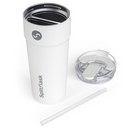
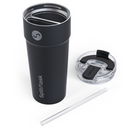
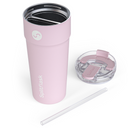
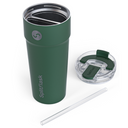
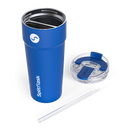
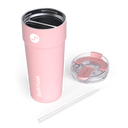
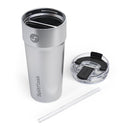
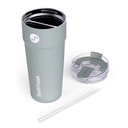
No. In the featured Splitflask, the combined capacity is 30oz: two 15oz chambers.
The bottom line
You can carry hot and cold liquids simultaneously when a tumbler has truly separate, suitably insulated chambers and is approved for the drinks' temperatures. Expect strong separation—not physically impossible “zero bleed”—and judge exact retention by transparent, repeatable product testing.